
Guérande salt: history, culture and craftsmanship of an essential ingredient
Salt as heritage, not just a detail
In a world where salt is often considered a mere seasoning—industrial and anonymous—Guérande salt brings us back to its true nature: a cultural ingredient, born from the earth, climate, and human labor. For over a thousand years in Brittany, it has been harvested by hand using unchanged techniques, without refinement, treatments, or additives.
It's not just any salt: it's a vibrant, territorial, profound product, telling the story of a region and its people.
Where is Guérande?
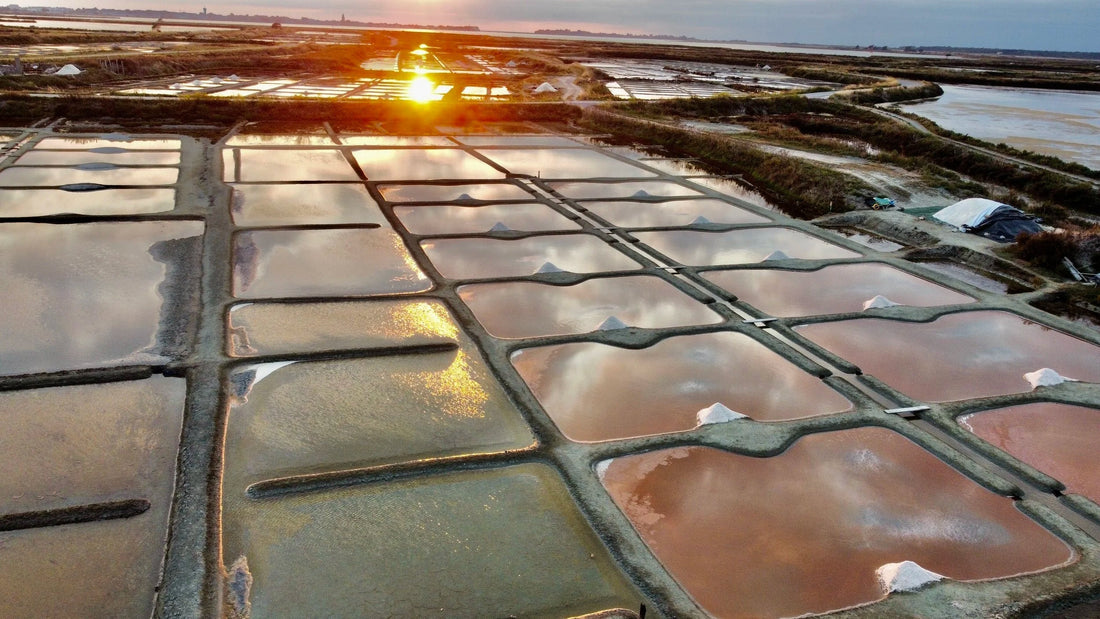
Guérande is located in Loire-Atlantique, a few kilometers from the sea. Surrounding the city are over 2,600 hectares of salt marshes, among the largest in Europe, where one of the purest forms of marine agriculture is still practiced today.
The first documented traces of salt production date back to the 9th century, but the landscape, ingeniously shaped to channel ocean water, suggests a much older origin, likely Gallo-Roman.
How is Guérande salt produced?
The production of Guérande salt follows a natural cycle, without machinery, fossil energy, or chemicals. It's a slow process, entirely guided by natural elements: the sun, wind, clay, and human hand.
- Atlantic water enters the canals and distributes into a geometric network of basins called œillets.
- During evaporation, the salt concentrates and crystallizes.
- The paludiers, salt artisans, hand-harvest two types of salt:
- Gros sel, which settles at the bottom.
- The very precious fleur de sel, which floats to the surface only on perfect, calm, and dry days.

A richness even underfoot
The clay base of the basins (bri) is an essential part of the quality of Guérande salt. Not only does it retain water without concrete or plastic, but it releases natural trace elements (magnesium, potassium, calcium) that bind to the salt, giving it a complex mineral profile and a rounded taste.
This is also why the salt's color is gray: it's not dirty, it's natural.
Regenerative agriculture and a living ecosystem
The Guérande salt marshes are not just a productive landscape; they are also a fragile and precious ecosystem, home to over 180 bird species, halophyte plants, and unique coastal biodiversity.
Salt harvesting, based on zero-impact techniques, represents a concrete model of regenerative agriculture: no mechanization, no soil erosion, zero emissions.
Producing salt this way is also an act of environmental protection.

Fleur de sel and gros sel: the two souls
Fleur de sel is the "flower" that floats to the surface: delicately harvested with a fine net (lousse), sun-dried, never washed or treated.
It is used raw, as a finish on meats, vegetables, desserts, or chocolate. It is light, fine, and aromatic.
Gros sel, more rustic, is perfect for cooking, brining, and broths. Both:
- are unrefined
- contain no anti-caking agents
- are unbleached
-
are never the same from one season to the next
Not just flavor: organoleptic qualities and health benefits
Guérande salt is not just tasty; it is also nutritionally interesting. Unlike refined industrial salts, which contain almost exclusively sodium chloride, this salt naturally retains a full range of minerals and trace elements, such as magnesium, potassium, calcium, iron, and zinc, thanks to the clay environment of the salt marshes and the absence of washing or refining processes.
From an organoleptic perspective, it is distinguished by:
- a delicate texture (especially in fleur de sel), which melts in the mouth without being aggressive
- a round and complex taste, with subtle mineral notes that enhance the natural flavors of foods
- an elegant aromatic persistence, which complements rather than overpowering
For this reason, it is often recommended in balanced diets where conscious salt use is required: a little goes a long way to achieve a full taste effect without overdoing the quantity.

Protected knowledge, a culture to pass on
In 2012, the savoir-faire of the Guérande salt workers was recognized as part of France's intangible cultural heritage. It is one of the few highly specialized agricultural trades that has remained intact for centuries.
Being a paludier today means:
- preserving a landscape
- passing down a tradition
- producing without destroying
Many young people in Brittany are returning to this profession, bringing new life to abandoned salt marshes, with a cooperative spirit, organic practices, and a strong commitment to sustainability.
Know more to choose better
Talking about Guérande salt is not about promoting a product, but about educating people towards a more conscious approach to what we put on our tables.
A salt like this is proof that even the simplest ingredients can tell a rich story, if they come from an authentic supply chain that respects the earth.
At the foundation of any good cuisine—Italian or French—there is not just technique, but the right raw material. And salt is the first step.
Sources:
- Artisans du Sel – Official blog
- INAO – Institut National de l’Origine et de la Qualité